TWO DAYS, TWO STORMS, AND THE BACK HALF OF A BOOK

Comment

TWO DAYS, TWO STORMS, AND THE BACK HALF OF A BOOK

I have searched for a way to tell this story. I have started it over and over for the past several months grasping for words - words that are well chosen, well placed, correct. And I have failed. This attempt will, I’m certain, also be a failure, because failure is inevitable here. Because this is about God. And thought and language are profoundly inadequate when it comes to God. Unfortunately, however, thought and language are often the only tools available (art, music, silence may get us closer, but they are not always at our disposal), which is, I suppose, why theology exists; as reasoning beings in the world as it is, we need ways in which to think and speak about things even — and perhaps, especially — when that thinking and speaking only serves to show us the degree to which our thoughts and language are limited in their reach. But I am risking digression into the general, when this is meant to be about the specific. I should, I think, simply dive right in, for it finally occurs to me after all of the scrapped attempts at writing this story, that the best I can do is to present it as I wrote it on the two days when it happened. And so…

8/17/19

I was tired. Exhausted. I had no business staying awake. But some months ago I began reading Surprised by Joy, C.S. Lewis’s autobiographical account of the first three decades or so of his life leading up to his conversion to Christianity, and I felt compelled tonight to continue. I was well into the second half of the book, and though I had found the account of Lewis’s early years interesting and quite readable, it had not been particularly affecting. Tonight, however, as I began to read, moving ever closer to Lewis’s telling of his own religious conversion, something was different. I felt the book’s chronology sweeping forward to meet me in my present. It was as if two lines — one representing the story of Lewis’s life and the other the story of my own life — had gradually been moving toward intersection, and here, in Lewis’s recounting of his reluctant turn from atheism, was that intersection. Every word resonated within me. It all felt so purposeful, so full of meaning and import. And in Lewis’s words: “For the first time I examined myself with a seriously practical purpose. And there I found what appalled me; a zoo of lusts, a bedlam of ambitions, a nursery of fears, a hareem of fondled hatreds. My name was legion.” This cut me, broke me, sent me reeling. I wept.

At this point, I needed a break from reading - a moment to clear my head - so I walked outside to the front porch. A storm was in the western distance. I counted the seconds for each lightning strike. One Mississippi. Two Mississippi. All the way to twenty-five. Then a quiet rolling thunder. Five miles. I collected my thoughts as best I could and went in to read more. Every page, every sentence, every word seemed meant for me.  I read and thought and considered. And the storm approached. And then — I can think of no other way to put it — I was called back outside. There is certainly a part of me that would like to somehow soften that and say it another way, but truly, it felt I was called. I haven’t believed in any “calling” of that sort for two decades, but this felt as real as the storm itself. I once again set the book aside and walked toward the door. I said aloud to myself “This is your storm.” It’s not that I believed that the storm’s existence was only for me. But a storm, like anything else, can have multiple purposes and meanings or perhaps none of either, and I felt — I feel— that regardless of whatever else that storm was meant for or whatever degree of purposelessness it had, it was also meant for me.

I opened the door to pouring rain and brilliant lightning crashes. Had I been counting at that point, the seconds would have been far fewer, but this seemed no time for counting. For several minutes I just watched. Is this God speaking? What do you want? How do I listen? I put my hand out into the downpour, reaching for whatever was out there, whatever had called me. For a few moments — nothing. And then a great flash that lit the ground and sky with all the illuminating power of a bright mid-summer day and an almost simultaneous crash that shook the house - shook the ground. No counting of seconds necessary (or even possible). I jerked my hand back. More than that - I pulled my entire body quickly and almost involuntarily back away from the rain under the overhang of the porch, chills up my back and neck. The fear of God? Perhaps. I stayed just a bit longer to watch and wait, tentatively, respectfully, fearfully. One more crash at least as loud as the one before. A little start… and then I laughed. Ok. You win. I’ve spent 20 years not believing in signs, not believing in miracles, sure that even if there were a god, that god would not likely be the kind that intervenes in the physical world. Suddenly, though, the world was different. Or — more accurately, I suppose — the world was just as it had been; I now saw it differently… because I was different.

I came back in, finished the book, and sat for a while contemplating what had just happened to me. After a while, a second wave of the storm moved in. Once more out to the porch. I sat and watched. The lightning and thunder were still raging, but slightly more at a distance. I witnessed the power, but felt safe and appreciated the grandeur and beauty of it all.

“God was to be obeyed simply because He was God.  Long since, through the gods of Asgard, and later through the notion of the Absolute, He had taught me how a thing can be revered not for what it can do to us but for what it is in itself.  That is why, though it was a terror, it was no surprise to learn that God is to be obeyed because of what He is in Himself.  If you ask why we should obey God, in the last resort the answer is, ‘I am.’  To know God is to know that our obedience is due to Him.  In His nature His sovereignty de jure is revealed.”


-C.S. Lewis from Surprised by Joy

8/18/19

The Encore.

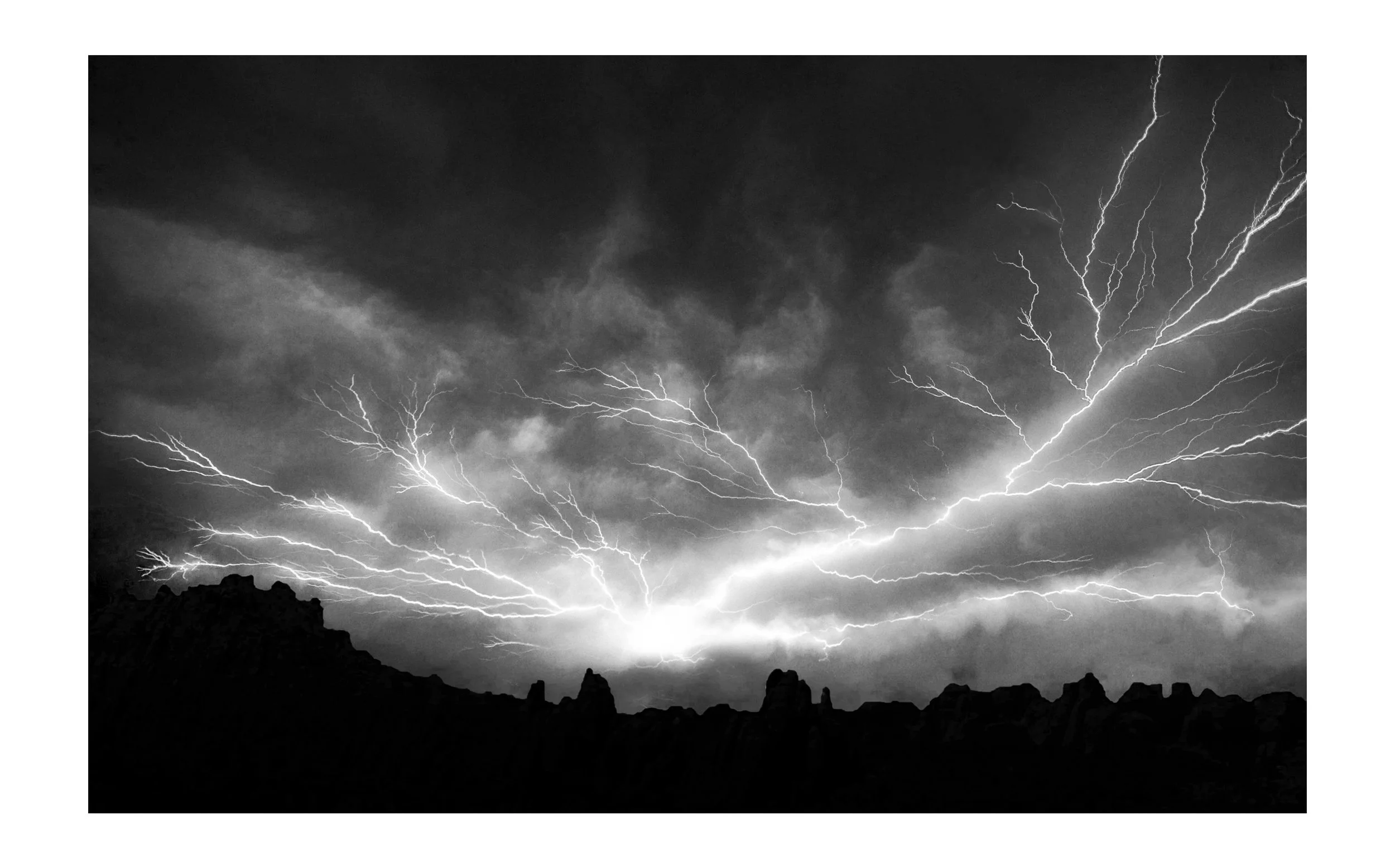
I taught lessons today. My last student cancelled so I left early just in the wake of some more intense storms. I drove home as the sun was getting low in the sky on a cloudy evening. I forgot I had to pick up photos from Walgreens. Turned around. Drove back. Wrong Walgreens.  Had to keep going and began to notice the strange yellow light of this sunset caused by an unseen sun sending rays around the end of a wall of gray clouds. Got the photos. The light grew more intense and stranger. Made one more quick stop. By the time I came out the light had become like nothing I’d ever seen - almost otherworldly. And here again I felt the “voice” of God. I drove toward the light - a bright outline at the edge of the aforementioned wall of clouds, rays visibly projecting through the sky from behind it. And once it was all in full view, I turned from heading west to heading north toward bluish gray storm clouds. A lightning show above an oddly lit landscape in which everything was either silhouette, light, or yellow reflection. A more gradual turn to the northeast only to come upon a visibly solid rainbow up against and beneath the dark of the storm clouds and the coming night - a rainbow in the darkness. And again, I began to laugh. This was like a show - beauty so awe-inspiring that it was teetering at the edge of the absurd. Almost too much. Almost. A turn to the east and more storm clouds, then, stretching out across the sky above me, a bright broad hundred fingered expanse of lightning the likes of which I have never seen. As I pulled into the neighborhood, the rainbow disappeared, the lightning stopped and an all too normal looking sunset was nearing its end. Had I been in lessons for the normal scheduled time, I would have missed it all. Had I gone to the right Walgreens in the first place I would have missed it as well. But there was a cancellation and I did go to the wrong place. And I didn’t miss a moment.

And that’s it. Two days of my life recounted in part. Two days of change. I was an atheist-leaning agnostic who, more than twenty years ago, abandoned a Christianity in which I felt I could no longer justifiably believe. Two days, two storms, and the back half of a book… and I come out on the other side, somehow… a Christian?  I suppose so.
Comment

THE DEPTH AND DARKNESS

Comment

THE DEPTH AND DARKNESS

God is down. God is underneath. God is hidden. God is in the darkness. I often find myself wanting to use such metaphors to describe my experience of God. I am well aware, of course, that such imagery runs contrary to the typical ways in which God is described, at least in the evangelical Christian tradition in which I grew up. God is light or resides in the light; God reigns from above; God is there in plain sight to be found if only we are willing to open our eyes and seek—these are the types of images that are more commonly used to describe God. And I don’t deny the helpfulness and aptness of such descriptions. I just find them incomplete. It may be (and I believe that it actually is) helpful in many cases to think of God as light or in the light, but when I look to my own experience, it seems utterly clear to me that there is a very real sense in which God is also in the depth and darkness.

I should, I think, take a moment to clarify what I do not mean when I say that God is in the darkness or in the depths. People sometimes use this sort of language to describe the felt presence of God even in the worst of times: “In my darkest hour, God was with me,” or so the line might go. And again, this is certainly useful imagery, but it is not the darkness of which I speak. Rather, when I say here that God is in the depth and darkness, what I am attempting to get at is a sense of the unknown, the unknowable, the unsayable, the ineffable, the mysterious, the mystical, the infinite. It is something akin to what the anonymous Christian mystic famously referred to as “The Cloud of Unknowing”. It is the space beyond the edges of reason and certainty. That is the depth and darkness of which I speak. That is where I found God.

I did not, however, go searching for God in those dark and hidden places. After all, one cannot find what one cannot see, right? No, I was searching in the light, as any sane person would. I shined the light of reason and knowledge on all of the places I could think to look. For more than twenty years I searched that way, confident that a conclusion would be lying around some newly investigated corner. I suppose I believed—if only I read enough books, listened to enough lectures, wrote enough words, thought enough thoughts—that eventually, one way or another, my agnosticism would fall away and I would find myself ready and able to make a definitive decision regarding the reality of God. But that day never came. An answer was never lying around any corner. Uncertainty held fast despite my best efforts to eliminate it.

And then one day…I gave up. I don’t know exactly what it was that flipped the switch, but it finally occurred to me that after two decades of searching, I was no closer to a definitive, rational conclusion about the reality of God than when I started. And another year, or five years, or twenty years wasn’t going to make the difference. So I let go. I accepted the uncertainty. I turned off the inquisitive light of reason, sat down, and rested in the deep darkness of the unknown. I said earlier that I found God in that darkness, but I don’t suppose that is exactly true. I am inclined to say instead that God found me, but that’s not quite it either; God who always knows us better than we know ourselves never needs to “find” us. No, I think the best I can do is to say that it was in that darkness that I was finally able to sense God, who had been there (and everywhere) all along.

Comment

TURNING PAGES

1 Comment

TURNING PAGES

I have refrained from telling the story that follows. I have procrastinated. I have deferred. I have deflected. I have detoured. Because I am, well… afraid. Afraid and proud. I am, I suppose you might say, trying to be something other than my true self. I am hiding. I am covering a candle with a basket. I have been called to something, and I have tried to reshape that calling into something that it is not.

A couple years ago, as you may know if you’ve come across a few of my longer posts since then, I returned to a faith and belief in Christianity after two decades of agnosticism leaning toward atheism. Much of that return to faith has been rooted in a kind of unknowing—a willingness to accept mystery and the limits of reason and rationality. And I’ve been perfectly happy to talk and write about that sort of thing. This idea of unknowing and believing that truth extends beyond the grasp of our finite rationality comes up in lots of places from art to philosophy. It is a part of my Christianity, but it tends to go over well with those who don’t necessarily agree with my religious beliefs. It can come off as both academic and artistic—and I like to be academic and artistic. So that’s quite convenient, isn’t it?

But the story that I am about to tell, that I must say I feel utterly compelled to tell, does not allow me to simply wrap myself in the comfortable clothes of the artist/academic. It requires me to attest to a belief in the supernatural, the miraculous, the direct intervention of the divine in the real world, and thus it opens me up—or at least i feel (fear) that it does—to a kind of critique that I would very much prefer to avoid: that I am foolish, deluded, childish. I would like to protest. I would like to say that I did not sign up for that, but I suppose that’s not altogether true, is it? “He called a child, whom he put among them, and said ‘Truly I tell you, unless you change and become like children, you will never enter the kingdom of heaven. Whoever becomes humble like this child is the greatest in the kingdom of heaven.” (Matt. 18:2-4)

So…

___________________________________________

“I have known only one person in my life who claimed to have seen a ghost. It was a woman; and the interesting thing is that she disbelieved in the immortality of the soul before seeing the ghost and still disbelieves after having seen it. She thinks it was a hallucination. In other words, seeing is not believing. This is the first thing to get clear in talking about miracles. Whatever experiences we may have, we shall not regard them as miraculous if we already hold a philosophy which excludes the supernatural.”

C.S. Lewis from “Miracles” in God in the Dock


I was eighteen—maybe nineteen—years old when I experienced what I took to be a miracle. I was out of high school, taking some time off before college, still living at home with my family in the parsonage of the church where my stepfather was (and still is) the pastor. It was late. Everyone else in the house was asleep and I was upstairs in my room reading my Bible. I don’t recall for certain what I was reading—the Gospel of John, I think? . I had looked away from the Bible to think, perhaps to pray. Not for long. A matter of minutes. Maybe less than a minute. And when I looked back to the Bible, it was open to a completely different page. I was lying in bed, propped on my elbows, the Bible right under my face and I hadn’t noticed any turning pages. It was as if the pages had just…changed.

Now, I am and always have been a skeptic by nature, so I immediately began looking for a natural, rational explanation. I tried bumping and brushing up against the Bible, but the pages stayed put; it was clear that it would have taken much more than an unnoticeable nudge to turn them. I stood on a chair and checked the vent on the ceiling; air was blowing but it was having no noticeable effect on the pages. I searched and thought, but ultimately failed to come up with anything that would adequately explain the changing of those pages. And so, not knowing what I was looking for, I turned my attention back to the Bible and I began to read until I came to this:

But get up and stand on your feet; for I have appeared to you for this purpose, to appoint you to serve and testify to the things in which you have seen me and to those in which I will appear to you.” (Acts 26:16)

It is an excerpt from the apostle Paul’s recounting of his conversion experience. But for me in that moment it was a calling—God reaching out into the world to speak directly to me. It was a pivotal, meaningful moment that gave me a sense of purpose. It was an answer to prayer.

A few short years later, however, I would come to dismiss it altogether, its memory relegated to a dark, quiet room at the back of my mind where it would reside comfortably for more than two decades. You see, over the course of the few years following the event which I just described, I came to a point at which I felt I had to abandon my faith. In retrospect, I suppose I would actually say that what I abandoned was not really faith at all, but rather a strictly intellectual belief system that I felt had been irreparably undermined. I could go into much greater detail about the process that led me to unbelief and about this idea of the differentiation between belief and faith, but I will mostly save those discussions for another time. For now, it will suffice to say that I came to possess a worldview that did not allow for miraculous page turnings, hence that memory’s relegation to its comfortable room. It was not forgotten; it simply lost its meaning and import. I didn’t explain it away. I didn’t have to. My philosophy insisted that a natural explanation must exist whether I could find it or not. There were, as I had come to see it, no other possibilities. Case closed. Enjoy your quiet room, dear memory.

But, of course, things change, don’t they?

In August 2019, I found a renewed faith and belief in God and Christianity as the result of events which I have detailed elsewhere and which I experienced as the undeniable voice of God speaking into my life. It was not long after that that the old memory of the pages turning began to stir, to move out of its dark room, to speak, to remind:

“But get up and stand on your feet…”

I was not immediately sure how much attention to pay it. After all, belief in God does not entail belief in supernatural occurrences. Nor does belief in supernatural occurrences entail belief in all purported experiences of them. In other words, my newly discovered faith and belief in God did not mean that I was required to accept the reality of that miracle which I had long ago dismissed. Perhaps the memory would return to its room. Perhaps that is where it belonged.

“But get up and stand on your feet; for I have appeared to you for this purpose…”

But the reminders remained present and persistent in my consciousness—a return to mental obscurity seeming increasingly unlikely—as my once quiet, innocuous, little memory set up camp in broad daylight and announced itself loudly, clearly, and constantly right at the front of my mind. I found myself continually returning to the words I had read all those years before:

“But get up and stand on your feet; for I have appeared to you for this purpose, to appoint you to serve and testify to the things in which you have seen me and to those in which I will appear to you.”

And ultimately, I came to re-embrace the supernatural quality of the miraculous page turning for two primary reasons.

First, I had never adequately explained it away. I hadn’t even inadequately explained it away. I simply had no explanation. And when I began to really reconsider the memory of that experience, I recalled just how inexplicable and miraculous it felt in the moment. On that night in that room I was skeptical, awake, and aware, and despite my best efforts, I could not find a plausible natural explanation for what happened.

My second reason for accepting that the page turning was indeed supernatural is a bit more difficult to put into words. It is less rational, but perhaps more important and convincing. I suppose I might put it this way: both the experience I had and the calling that came along with it have the ring of truth to them. And not just truth, but divine truth. They strike me internally as possessing a weight, a depth of meaning and reality, an undeniable glimmer of that which is sacred, holy, transcendent. When I consider the memory of that experience, I find myself filled with a deep sense of assurance that goes beyond rational grounding. It is this internal sense of assurance, I think, that provides the ground of faith—the assurance of things hoped for, the conviction of things not seen. (Heb. 11:1)

I am left then with the question of what to do with a calling: “…I have appeared to you for this purpose, to appoint you to serve and testify to the things in which you have seen me and to those in which I will appear to you.” What does that entail? What is required of me? Rest assured, I have had ideas and plans over the last year or so—a book, a series of talks, a concept album, a show that tells my story through both music and spoken word, etc.. Lots of thinking. Lots of planning. Lots of waiting… Not, however, an awful lot of doing. And my planning seems to always end in frustration. It may be the case that some of these ideas that I’ve had will come to fruition at some point, but I am finding that in moments of silence and clarity I keep feeling a call to simplicity, a call to stop over-complicating and under-delivering, to simply say what I’m meant to say and trust that doing so will be enough, to take a small first step and know that the next step will become clear in good time.

And so I am trying here to take that simple first step by writing this and putting it into the world—“…to serve and testify to the things in which you have seen me…” And it occurs to me only now that some of my planning and waiting might be better characterized as pride and procrastination. Because if I’m honest, I have to admit that there is a part of me—perhaps a more significant part than I would like to admit—that would rather not say these things. It is surely no accident that for more than twenty-five years, I haven’t really spoken to anyone about what happened that night in my room. That is, no doubt, partly due to the fact that for so long I didn’t believe in the possibility of the supernatural. But even now, having come to a new faith and belief in Christianity, I have kept this story mostly under wraps. In fact, I have had all of this mostly written for months and have done exactly nothing with it. And I think that it also has something to do with my own pride and wanting to be thought of by certain people in a certain way. It is one thing to profess Christianity, broadly speaking. It is quite another to go around talking about believing in miracles.

But here I am.

Of course, you are completely at liberty to dismiss all of this. You may think I am sadly deluded. And if, in fact, that is what you think, well it isn’t so long ago that I would have agreed with you. And even now I have no proof that you are wrong. Proofs are not available here. There is only testimony—my anecdotal memories and my claims of faith and internal assurance. That is what I have to offer, however imperfectly. That is what I feel called to tell you. And so with uncertainty and trepidation I submit this to you—without a clear sense of purpose, without an expected result. All I can do is say—to you and to God—“Do with it what you will.” I hope, trust, and pray that some good comes of it.

Peace.


1 Comment